


Previous | Explore Topic | Next
Hand in Hand, Hearts at Ease
They built a life with full, fast pace,
That wore them thin in endless race.
Days blurred by, with moments missed,
Yearning for peace, a life less brisk.
In quiet walks and simple grace,
They found a rhythm, a slower pace.
Hand in hand, their hearts at ease,
A life with balance, calm, and peace.
Ever wonder how to create a full and flourishing life for yourself?
It starts with balance. We must balance our focus between ourselves and others, nurturing our own growth while contributing to the world around us. Life also calls for balance between our inner world, our thoughts and emotions, and our outer world, the physical and tangible aspects of life. And to feel fully alive, we need to balance our energy, with periods of activity and excitement as well as times of rest and contentment.
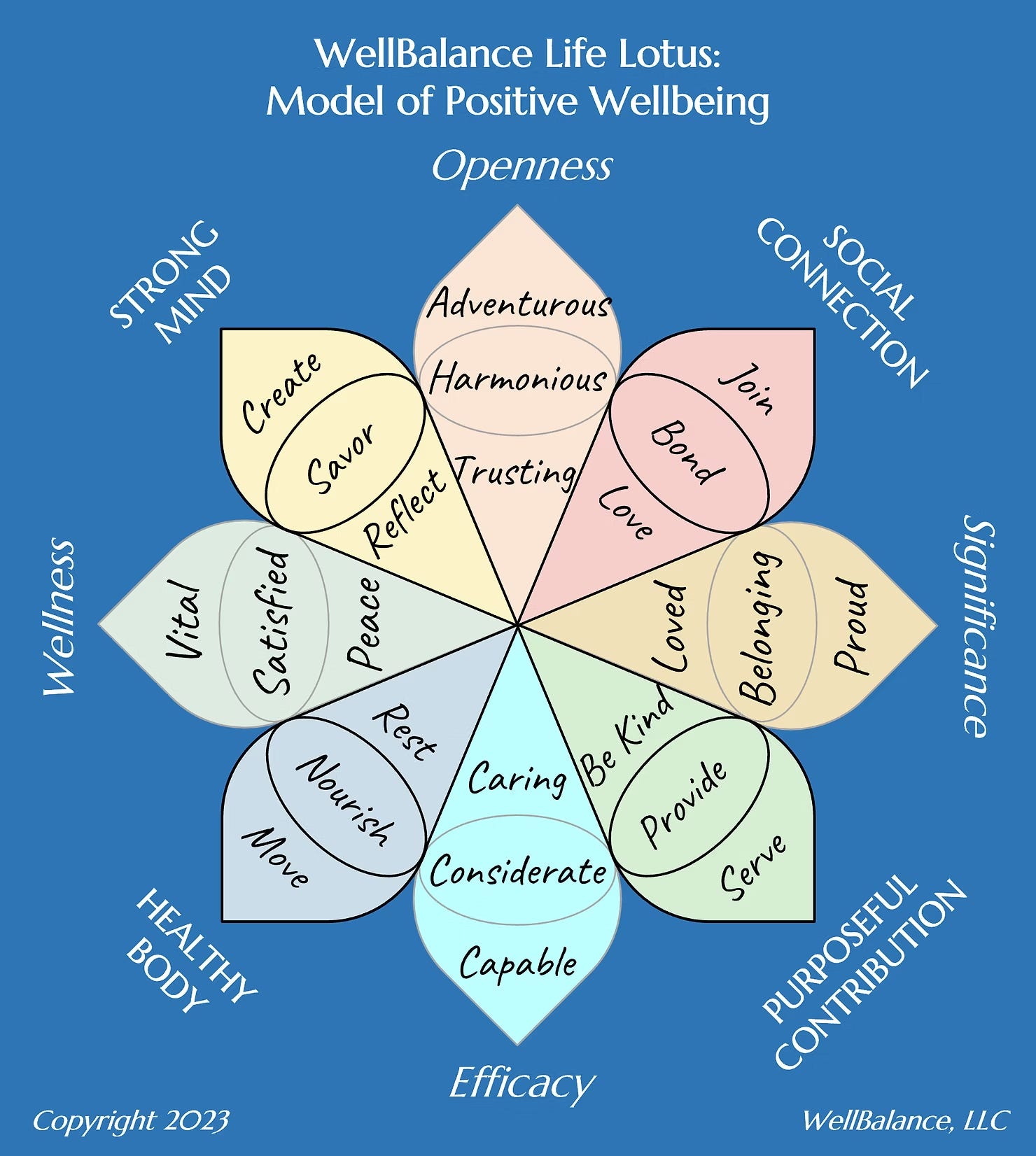
You have now been introduced to the WellBalance Life Lotus as a map of flourishing. Now let’s step inside that map and begin seeing your own life through its petals. Rather than trying to perfect every area at once, begin by noticing where your life already feels nourished, where it feels stretched thin, and where one small shift could restore greater balance. This isn’t a model to be mastered, but to be used as a mirror, a compass, and a gentle guide for whatever part of life you are in now.
Many people want a “balanced” life, and yet balance will never look exactly the same for everyone. One person may need more rest because they’ve spent years pushing through exhaustion. Another may need more connection because they’ve slowly and quietly become isolated. Someone else may need more purpose, more movement, more creativity, more joy, or more peace. We share many of the same human needs, but the way those needs show up in each of our lives is deeply personal.
This is why the Life Lotus isn’t a prescription to be followed rigidly. It’s meant to help you ask better questions. Where do you feel alive? Where do you feel depleted? What parts of your life give you strength? What parts keep asking for attention? Your answers may change across different seasons of life, so the path to recentering will change too. A balanced life requires continual tending. It isn’t something we build once and finish.
Seeing Your Own Pattern
Many people seek out wellbeing because something feels off. They may be doing well by the usual measures, working hard, caring for others, managing responsibilities, and still feel tired, disconnected, restless, or emotionally flat. From the outside, their life may look full, while from the inside it feels narrow.
You might recognize this in yourself. Maybe you have been taking care of everyone else while quietly neglecting your own body, creativity, or rest. Maybe you have been investing so much in achievement that your relationships have become thinner than you intended. Perhaps your life has comfort and stability, but you miss adventure, learning, or a sense of growth. Or maybe you have deep insight into yourself, but you struggle to turn that insight into action.
The WellBalance Life Lotus helps us see these patterns with more compassion and less judgment. It doesn’t ask, “What is wrong with me?” It asks, “What part of my life needs more attention right now?” This simple shift matters. When we see imbalance as information, rather than mistakes or failures, we can respond with wisdom and self-compassion instead of shame or regret.
Your pattern will also likely include real strengths. Some petals of your life may already be blooming brightly. You may be naturally relational, deeply purposeful, physically disciplined, creatively engaged, spiritually reflective, emotionally aware, or good at creating calm. These strengths matter. In addition to being signs of what’s going well, they are resources you can use to support the parts of your life that need more attention.
Your Balance Will Be Different from Someone Else’s
Many wellbeing approaches sound simple from a distance: exercise more, sleep better, be grateful, connect with others, find your purpose. These are all well founded suggestions, and they can help. But real life and real people like you are a lot more complex. The same practice that nourishes one person may feel overwhelming to another. The same life passage that drives one person into growth may force another into recovery.
One person may feel most alive in high-energy experiences, surrounded by people, projects, movement, and possibility. Another may feel most whole in quiet moments of reflection, deep conversation, spiritual practice, or time in nature. One person may need to learn how to slow down. Another may need to reawaken motivation after a long period of grief, burnout, or disappointment.
This is why balance is personal, reflecting the circumstances and season of life you are in right now. It depends on your body, your relationships, your responsibilities, your history, your values, and your aspirations for growth. At certain times in life you may choose to focus more heavily on certain parts of life than others. A young parent, a caregiver, an empty nester, a student, an entrepreneur, a person healing from loss, and a person beginning again after a major life change may all need different forms of balance, with different paths and timelines to recenter.
The WellBalance Life Lotus provides a shared language, grounded in the science of positive psychology, while leaving room for our unique lives to flourish in our own ways. We all need connection, contribution, purpose, vitality, mental strength, positive feelings, and a healthy rhythm of energy. But we each need to discover what these look like in our own daily life, with the time, capacity, support, and desires we actually have today.
Noticing What Feeds You
A helpful place to begin is by noticing which experiences naturally feed your wellbeing. Some people feel restored through connections. A long conversation, a shared meal, a loving relationship, or a sense of belonging can help them feel grounded and alive. Others feel nourished through contribution. They feel most like themselves when they are helping, mentoring, creating, providing, or making a meaningful difference.
Some people return to themselves through their body and the physical world. Movement, healthy nourishment, sleep, sunlight, fresh air, mindful breathing, and physical care give them strength and steadiness. Others come alive through their minds. Learning, creativity, reflection, beauty, spirituality, and curiosity help them feel open and engaged with life – and with themselves.
Most of us need all of these, although not in equal measure at every moment. The goal isn’t to force equal attention to every part of your life each day. Your task is to learn what nourishes you, what you tend to avoid, what you overuse, and what you might have forgotten or never tried.
Begin by asking: Which parts of my life reliably give me energy? Which parts give me meaning? Which parts help me feel loved, capable, peaceful, or open? Which parts have become too small? These questions help turn the Life Lotus from an idea into a living practice.
Noticing What Is Missing
Sometimes the most important part of the Lotus is the part that has been neglected. Many people overdevelop one part of life because it feels intrinsically rewarding and is often reinforced by external praise, recognition, or signals of success. Someone praised for achievement may keep striving long after their body asks for rest. Someone valued for caregiving may keep giving long after resentment begins to build. Someone admired for independence may struggle to ask for help. Someone skilled at reflection may stay in thought rather than taking the next brave step.
These patterns often arise from our strengths. Achievement, caregiving, independence, reflection, and responsibility can all be beautiful. But they can also become costly when they crowd out other important parts of our lives.
You might notice this in subtle ways as you listen to what your body and emotions are telling you. A lack of energy may point to the need for rest or better care for the body. Loneliness may be asking you to seek deeper social connections. Restlessness may lead you toward adventure, creativity, or purpose. A sense of numbness may suggest that life has become too routine, too pressured, or too disconnected from what truly matters to you. Irritability may reveal that you need to rest because too much has been asked of you for too long.
The WellBalance Life Lotus provides a lens through which to hear and interpret these signals. It helps us see discomfort as direction. Rather than blaming ourselves for feeling off-balance, we can ask what our life is trying to tell us and proactively take small steps back to our center.
From Experiences to Feelings
Positive experiences matter because they shape how life feels. Connection, contribution, care for the body, and flexing your mind can blossom into feelings of significance, efficacy, wellness, and openness. Simply notice which feelings already bloom most naturally in your life and which may need more encouragement.
Many people know what they do each day, yet they rarely pause to ask why they are doing them or how those experiences make them feel. A calendar can look productive while the heart feels empty. A routine can look healthy while the mind feels bored. A social life can look active while the person still feels unseen. A peaceful life can look calm while the spirit longs for growth.
So often, we cede control over our daily lives to others, becoming “human doings” rather than human beings. We forget that we have both the agency and responsibility to shape our own lives. This is why we need to look beneath the surface of activity. Beyond “What do I need to do today?”, the deeper questions are “Who do I want to be today?” and “How are these experiences shaping my life?”
Do your relationships help you feel loved, known, and supported? Does your work or service help you feel useful and meaningful? Does your body feel cared for, strong, and steady? Does your mind feel curious, present, and clear? Do your daily choices help you feel more open to life, or more closed down?
When we begin to connect our experiences with our feelings, we gain more freedom. We can stop pursuing activities simply because we think we should and start choosing experiences that truly nourish the life we want to live.
Honoring Your Energy Rhythm
Your Life Lotus also has a natural rhythm. Some experiences activate you. Some bring you into mindful presence. Some help you rest and recover. To truly flourish, we need to cycle among all three fluidly.
Many people live too long in one energy state – overly active, overly restful, or sometimes even overly mindful. Some stay in high-energy doing, pushing from one task to the next until even good things begin to feel heavy. Others get stuck in low energy, not out of laziness, but because exhaustion, grief, discouragement, or lack of support has made movement feel hard. Or perhaps they intentionally focus so much on inner peace and reflection that they neglect the world around them. And most of us simply move through life with more distraction than presence, missing the beauty and meaning already available in ordinary moments.
At any point in time, you may need more movement, more stillness, or more mindful attention. You may need fewer demands, or you may need a small challenge that awakens your spirit. You may need the energy of people, or the quietness of solitude. You may need to create, walk, dance, sleep, pray, organize, reach out, or simply breathe. A balanced rhythm doesn’t require the same pattern every day. Some seasons of life, especially periods of major transition, require more effort. Others require more healing. Some days call for boldness. Others call for gentleness. What matters is whether your rhythm supports your life over time.
The key is to listen to and honor the signals your mind and body are continuously sending you. Try asking yourself: Am I living at a pace that my body and heart can sustain? Do I have enough experiences that energize me? Do I have enough moments that settle me? Do I have enough presence to actually feel the life I am living?
Choose One Small Shift
Once you begin to see the pattern of your life today, you might be tempted to overhaul your life. Instead, choose one small shift that starts with where you are and reflects the direction you want to go. We often try to change too much at once. We decide to exercise daily, reconnect with every friend, sleep perfectly, meditate every morning, eat better, journal, volunteer, and find our purpose, all in the same week. Not only will that approach create more pressure than progress, it risks pulling us out of balance in a different direction.
The WellBalance Way begins more gently, aiming to catalyze upward spirals through an accumulation of simple steps. One small change can create movement. A ten-minute walk. A call to someone you miss. A quiet cup of coffee without your phone. A bedtime that respects tomorrow’s body. A moment of gratitude before sleep. A kind message. A boundary. A breath before responding. A choice to begin again. The goal isn’t to give equal time to every aspect of life. Small doses of peace or joy can carry us through the rest of our day.
Small changes are also easier to repeat and begin to build lasting habits over time. What we repeat begins to shape how we feel, how we see ourselves, and what we believe is possible. Over time, one small shift can open the door to another, with yet another door beyond that door that we couldn’t see before. You do not need to fix every petal of your life today. You only need to notice where life is asking for more care and attention and take one small step in that direction.
Living Your Lotus Over Time
Your Life Lotus will change as you change. What you need in one chapter of life may differ from what you need in the next. The balance that supported you five years ago may not fit the person you are becoming now.
This is especially true during transitions. A new relationship, a breakup, a birth, a loss, a move, a career change, an illness, a freshly empty nest, a retirement, or a spiritual awakening can all shift the shape of your wellbeing. During these times, we often feel unsettled because an old way of living no longer matches a new version of ourselves. And yet these times are the greatest opportunities to return to ourselves and build a life even more true to, and aligned with, who we have become.
The WellBalance Life Lotus can help you navigate these changes with more clarity. It can help you ask: What used to nourish me that no longer does? What new part of me is asking to grow? What support do I need now? What can I release? What can I reclaim? In this way, the Lotus becomes more than a scientific model of wellbeing, but a companion for self-awareness across the seasons of your life. It reminds us that balance is responsive, not fixed, and grows with us as we grow.
Cultivating a Well-Balanced Life
Living a balanced life is a dynamic process of awareness, adjustment, and care. A life in balance doesn’t eliminate stress or prevent painful emotions. It gives us a broader and more resilient foundation from which to meet life’s challenges, embrace our agency and responsibility, and recognize the signals and motivators to act, change, seek connection, or simply rest. By grounding ourselves in positive experiences, fostering a balanced life, and savoring the good that is already present, we create a foundation where difficult events or emotions can be managed more effectively, without overwhelming our wellbeing.
When we nurture different sources of wellbeing, we become less dependent on any single role, relationship, achievement, or routine to hold our whole sense of self. When one area becomes strained, other parts of life can still offer steadiness, meaning, and support. Hardships will still feel hard, but our overall lives will become less fragile.
In a world that is constantly pulling us out of balance, learning to recenter and paying attention to what matters is one of the most powerful ways to improve our quality of life. We can live in closer alignment with who we are, what we value, and how we want to show up. Through the WellBalance Way, you can design a life that celebrates activity and rest, connection and self-care, appreciation and aspiration.
Your Life Lotus doesn’t need to bloom all at once. You just need to tend to it and give it the care it needs to continue to grow. Begin where you are. Notice what’s already alive in your days. Notice what’s missing and choose one small act of care, whether for yourself or for others. Then let that choice guide you toward a wider rhythm that helps your life become more connected, resilient, meaningful, and whole.
Reflections on Your Life Lotus and Balance
1. Defining What Balance Means for You
Consider a time when your life felt in balance? What habits, choices, and circumstances contributed to that sense of balance? How can you bring more of those elements into your life now?
Balance doesn’t mean perfection. Instead, it’s about attending to the different areas of your life in a way that feels fulfilling and sustainable. Where do you feel most balanced right now, and where do you feel off-balance? What adjustments could help you feel more aligned?
2. Cultivating a Full Spectrum of Positive Experiences
The WellBalance framework highlights four key areas of positive experiences – Social Connection, Purposeful Contribution, Healthy Body, and Strong Mind. Which of these areas do you naturally gravitate toward, and which do you tend to neglect? How could nurturing all four create a more fulfilling life for you?
Consider a time when a single positive experience, such as a meaningful conversation, an act of service, a physical activity, or a creative pursuit, had a ripple effect on other areas of your life. What did that experience teach you about the power of intentional positivity?
3. Nurturing a Full Spectrum of Positive Feelings
The WellBalance model emphasizes four core positive feelings – Significance, Efficacy, Wellness, and Openness. Which of these feelings do you experience most strongly in your life? Which one feels like it needs more attention, and how might you cultivate it?
Think of a time when you felt a deep sense of fulfillment – when your contributions felt meaningful, your body felt strong, your mind was engaged, or your heart felt connected. What specific emotions made that moment so powerful? How can you create more experiences that evoke these feelings?
4. Balancing Energy Across Activity, Mindfulness, and Rest
Reflect on your current energy balance. Do you tend to push yourself too hard without enough rest, or do you feel stuck in a rut without enough engagement? What adjustments can you make to better balance activity, mindfulness, and rest?
Think about a time when you felt fully alive and present in the moment. What kind of energy were you experiencing – highly active, mindful and aware, or peacefully restful? How can you create more opportunities to tap into that energy as part of your daily routine?
5. Adopting a Positive Mindset to Elevate Your Life
A positive mindset isn’t just about thinking happy thoughts, it’s about training yourself to notice, appreciate, and amplify positive experiences. How often do you consciously practice gratitude, savoring, or positive anticipation? What’s one way you can integrate these into your daily life?
Consider a recent challenge you faced. How might shifting your mindset, such as by reframing the situation, looking for lessons, or focusing on what’s still good, change your experience of similar challenges in the future?
6. Designing a Well-Balanced Life for the Future
Imagine yourself five years from now living a life in balance – one where you experience deep connection, meaningful contribution, vibrant health, and a strong, engaged mind. What choices or habits helped you get there? What small steps can you take today to move in that direction?
If you could choose one theme to focus on for this year or the next season of your life, whether it’s connection, growth, vitality, giving, or something else, what would it be? How will you begin to pursue this theme in the next few weeks?